Magic Grant Cocktail Hour
VirtualJoin us Monday and Wednesday nights at 8pm for informal, virtual cocktail hours to talk about your ideas, mingle with peers, and ask general questions about granting opportunities at the Brown
Join us Monday and Wednesday nights at 8pm for informal, virtual cocktail hours to talk about your ideas, mingle with peers, and ask general questions about granting opportunities at the Brown
Finding Strength in the Numbers: Growing Up Stories The Columbia-Barnard Mathematics Departments and the Columbia Statistics Department are proud to invite you to our inaugural Women in Mathematics and Statistics
News outlets rely on computation to tell some of the biggest stories of our time. They collect data when official sources have not. They build statistical models to uncover disparities,
News unfolds in places and every newsworthy event is shaped by the details of location. Those details might include the specifics of a neighborhood as it is today or of
The Brown Institute at Columbia Journalism School, in partnership with the Spring ’23 Columbia Venture Competition and Columbia Entrepreneurship, Innovation, and Design are pleased to announce a competition for Columbia
Drop by and learn about the Brown Institute's Magic Grants and other programs! The David and Helen Gurley Brown Institute for Media Innovation is a joint effort between Stanford’s School
Join the Brown Institute for a unique opportunity to learn about the latest trends in news product development! Our two-weekend event, taking place on February 25-26 and March 1, is led by industry leaders Dalit Shalom, Lead Product Designer at the New York Times, and Julia Beizer, Chief Digital Officer at Bloomberg Media. This news
Designs to Support Better Visual Data Communication Cindy Xiong, UMass Amherst Well-chosen data visualizations can lead to powerful and intuitive processing by a viewer, both for visual analytics and data storytelling. When badly chosen, visualizations leave important patterns opaque or misunderstood. So how can we design an effective visualization? I will share several empirical studies
The future of Data Science is Live and in the Browser Data science is a constantly evolving field, and as such, it is important to continually explore new ideas for improving the tools we use. In this talk, I will talk about two ideas that may change how and where we build these tools. First,
Join us for a spirited conversation with renowned data journalist Julia Angwin as she discusses How Data Happened: A History from the Age of Reason to the Age of Algorithms with Matt Jones and Chris Wiggins of Columbia. The book expands on the popular course the authors created and have taught for the past several
The Brown Institute for Media Innovation is pleased to host a visit to Columbia University by the U.S. Chief Data Scientist Denice Ross and Deputy U.S. Chief Data Scientist Dominique Duval-Diop. In a lecture on March 30, Ross and Duval-Diop will introduce the idea of “equitable data.” Through the Equitable Data Working Group, they have
Intelligence Augmentation through the Lens of Interactive Data Visualization The rise of large language models has brought new urgency to the future of human + machine partnerships. In this talk, I will use three research threads on interactive data visualization to better understand the balance between automation and augmentation. First, I will describe how new
Special Considerations for Science Graphics Jen Christiansen, Scientific American Science graphics are beholden to the same design principles as other types of graphics. But the information they hold is often the product of a process that a lot of people in your audience may not be familiar with. It's important to honor the fact that
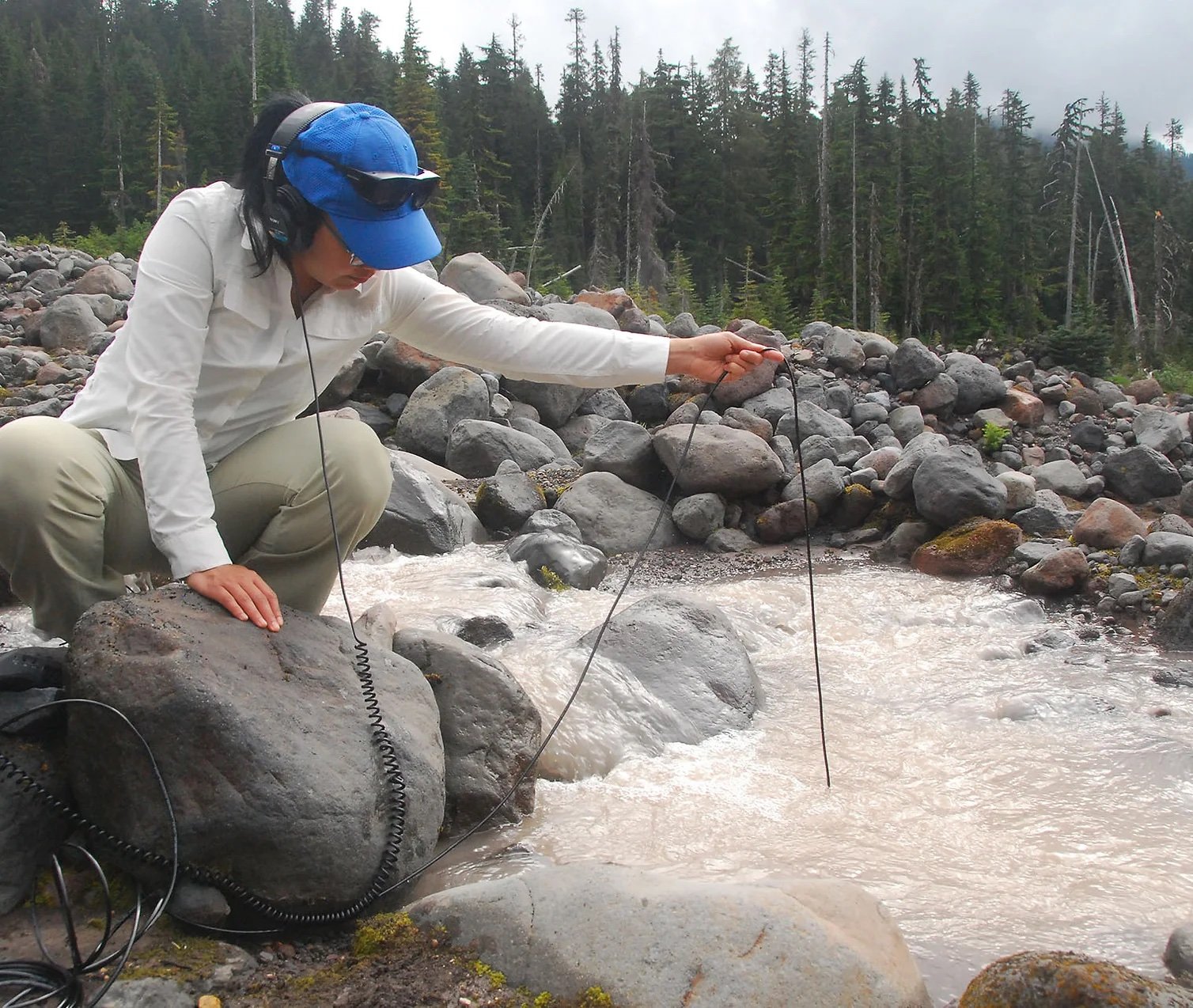
A screening and performance of composer, percussionist, and sound artist Susie Ibarra’s ambitious Water Rhythms: Listening to Climate Change (2020). Water Rhythms: Listening to Climate Change is a collaboration between Ibarra and glaciologist, geographer, and climate scientist Dr. Michele Koppes, which maps water rhythms from source to sink. Ibarra’s composition is derived from field recordings of five global watersheds, including the Greenland ice sheet and glacier-fed rivers of the Himalayas. It has also been installed at TED Countdown Edinburgh, Scotland (2021); ARKO Art Center, Seoul, Korea (2021); Fridman Gallery, Beacon, NY (2021); and the San Francisco Exploratorium (2022).
The Vagelos Computational Science Center (CSC) at Barnard College in partnership with The Brown Institute at Columbia Journalism School welcome you to Computing &, a series of panels exploring the complex and multifaceted role of computing in spaces of public life. Framed around the theme of 'Computing &', we will rotate through three crucial subtopics,