
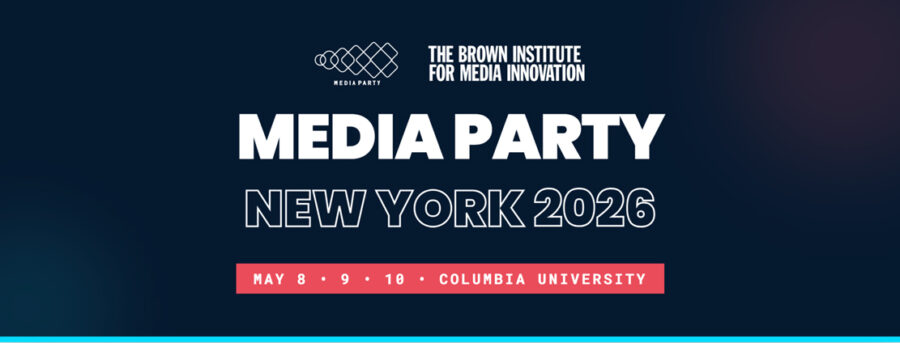
From May 8 to 10, 2026, Columbia University’s Brown Institute hosts Media Party NYC, bringing together 300 journalists, technologists, researchers, and entrepreneurs from around the world to take on the forces reshaping news: AI-driven workflows, shifting audience behavior, and the creators and platforms now mediating how people find information.
We’re in a post-search era. A generation now encounters journalism through individual creators and vertical video, and traditional consumers are increasingly getting their information straight from AI platforms. Not homepages, not search, not television broadcasts. Newsrooms worldwide are adopting generative AI tools, but unevenly, at different scales, applied to different problems, with results that range from genuine editorial advancement to cautionary failures. These shifts look different from Buenos Aires to Nairobi to New York, and understanding that variation is essential to any serious response.
At a critical moment for the industry, Media Party focuses squarely on this transition: exploring how newsrooms and content creators must adapt when AI reshapes the information landscape.
The Program
Media Party is not a traditional conference. It combines keynotes, workshops, a media fair, and a hackathon. It is a workspace designed to create the conditions for innovation to actually happen. Innovators from media organizations, small and large, technology providers ranging from startups to big platforms, and the scientific and open source communities will convene across four themes:
- News Influencers & Vertical Video
Individual journalists are increasingly becoming the primary distribution channel for news, building audiences on platforms optimized for personality over institution. What does this shift mean for editorial standards, ethical boundaries, and sustainable business models, and how creator dynamics differ across media markets worldwide? - Local News & Civic Technology
AI tools promise new capabilities for under-resourced newsrooms: automated translation, audience engagement, data analysis at scale. But implementation demands more than technology. How do we ensure that things as crucial as understanding community trust, local information ecosystems, and the specific vulnerabilities of civic journalism are valued by the platforms and systems we adopt?
Internal Tools & AI Workflows
Newsrooms are building and adopting AI systems with limited cross-industry collaboration and inconsistent evaluation. This track creates space for practitioners to compare approaches, surface what hasn’t worked, and develop frameworks for assessing AI tools in real production environments. - Audiences & Algorithmic Distribution
As AI-driven systems increasingly mediate discovery, news organizations must understand not only what they publish but how it travels and to whom. What strategies can we deploy to reach and retain audiences across fragmented platforms and diverse global markets?
Who Should Attend
This convening is for communications leaders navigating AI integration, developers building tools for journalism, researchers studying human-AI collaboration, entrepreneurs developing sustainable news models, and any professional interested in the civic technology ecosystem and the future of news.
“The most significant transformation that Media Party brings to its participants is the ability to forge lasting connections with unique players in the industry: media outlets, technologists, and global entrepreneurs. The sustainability and credibility of the media ecosystem must be accompanied by a network of shared relationships designed for the long term”, Mariano Blejman, Media Party director.